
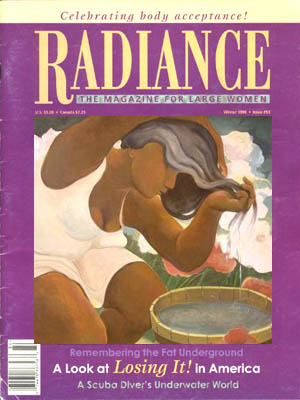
 Painting it Large
Compiled from an interview with Sandra Bierman by Alice Ansfield
The best years of my life have been the past ten year. My art has all come together for me.
I've always been an artist. But there were years in my life when I didn't paint. I put all my energy into working to support my children. For nine years, I was a telecommunications analyst in New York. I advanced to a second vice-president in telecommunications at Chase Manhattan Bank.
I returned to my art when my husband, Arthur Bierman, and I left New York City to live in the mountains in upstate New York. In 1988, we moved to Boulder, and, to my surprise, my art began to gain national recognition. I expected to just relax and have time to enjoy painting again. But it was like trying to start up an old rusty machine. I never expected my art to take off like it has. I wasn't even sure I could do it anymore!
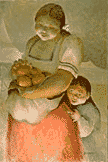 I paint large women, earth, nature. To me, large women are nurturing.
They have a soul. My grandmother was like that. She was a big, soft,
nurturing woman, who was part Cherokee. She always had a lap and a hug
for me. I spent a lot of my childhood living with her, because my mom
had schizophrenia and couldn't manage the family. I was sent hack and
forth to various "foster families." but I often stayed with my
grandmother in her log cabin in Oklahoma, Many of the feelings and
images in my paintings come from my impressions of this time with her.
She was my saving grace. I don't know if I would have survived without
her. She was a very patient, strong country woman, who was very creative
in her own way. She taught me how to make dollhouse furniture out of
cardboard, dolls out of corncobs-folk stuff like that. She wasn't well
educated, but she was a very wise woman. I felt very safe with her, and
loved.
I paint large women, earth, nature. To me, large women are nurturing.
They have a soul. My grandmother was like that. She was a big, soft,
nurturing woman, who was part Cherokee. She always had a lap and a hug
for me. I spent a lot of my childhood living with her, because my mom
had schizophrenia and couldn't manage the family. I was sent hack and
forth to various "foster families." but I often stayed with my
grandmother in her log cabin in Oklahoma, Many of the feelings and
images in my paintings come from my impressions of this time with her.
She was my saving grace. I don't know if I would have survived without
her. She was a very patient, strong country woman, who was very creative
in her own way. She taught me how to make dollhouse furniture out of
cardboard, dolls out of corncobs-folk stuff like that. She wasn't well
educated, but she was a very wise woman. I felt very safe with her, and
loved.
 My mom (Martha Blair) was a farm girl from Texas, and my dad (John
Riesberg) was from Sweden. They divorced when I was four, and my mom and
sister and I went to Oklahoma to live. Later, we all moved to Houston
and lived in the city housing projects. It was a very hard, bleak scene,
and I was a little girl with out much self-esteem. Every year for the
first ten years of school, in the middle of the term, I would change
schools, either to live with someone else, or my family had to move. I
think that's why I gave up remembering the names of my class-mates. I
knew I'd be leaving soon. To this day, I still have trouble with names.
Some of my teachers thought I was retarded because of that and my
dyslexia. My attention span was nonexistent. I just wasn't there. When I
was twelve, my Aunt Cleo had me tested, and I found out that I was quite
above aver-age in intelligence, which was good for my low self-esteem.
My mom (Martha Blair) was a farm girl from Texas, and my dad (John
Riesberg) was from Sweden. They divorced when I was four, and my mom and
sister and I went to Oklahoma to live. Later, we all moved to Houston
and lived in the city housing projects. It was a very hard, bleak scene,
and I was a little girl with out much self-esteem. Every year for the
first ten years of school, in the middle of the term, I would change
schools, either to live with someone else, or my family had to move. I
think that's why I gave up remembering the names of my class-mates. I
knew I'd be leaving soon. To this day, I still have trouble with names.
Some of my teachers thought I was retarded because of that and my
dyslexia. My attention span was nonexistent. I just wasn't there. When I
was twelve, my Aunt Cleo had me tested, and I found out that I was quite
above aver-age in intelligence, which was good for my low self-esteem.
I've been artistic for as long as I can remember. Throughout my childhood, during all the hard times, I'd go off in a corner and draw, or climb a tree and draw, or lie in my bed and draw. Drawing was a consistent thread in my life, a refuge. I remember always being out of notebook paper for schoolwork because I had used it all for drawing. My teachers started asking me to draw for different classroom projects. They'd set me up in the back of the room while the other students were studying the usual things. I missed out on a lot of schoolwork, but I had fun. Usually, I was drawing and not paying attention anyway! In third grade, I was singled out for a citywide scholastic achievement award. At twelve, I won my first scholarship to a watercolor class. And upon graduation from high school, I was awarded a full four-year scholarship to the Maryland Institute of Art.
 What I find in my paintings is that the style, subject matter, and
composition are consistent throughout my work, but the techniques I use
are constantly changing. I just switched painting methods again this
week. I like to vary the texture of the canvas and the way the paint is
applied. I'd be bored doing it the same all the time. Art, to me, is a
journey of exploration: exploration into myself. The journey is what
it's all about, not the finished product. It's the doing that is the
joy. My husband, a retired physicist, is writing a book. He works at
home in his study, and I'm at home in my art studio, painting. We have
an intercom so we can check in during the day and have lunch together.
He isn't at all interested in art. At all. We do both like nature and
taking walks together, and having our philosophical talks.
What I find in my paintings is that the style, subject matter, and
composition are consistent throughout my work, but the techniques I use
are constantly changing. I just switched painting methods again this
week. I like to vary the texture of the canvas and the way the paint is
applied. I'd be bored doing it the same all the time. Art, to me, is a
journey of exploration: exploration into myself. The journey is what
it's all about, not the finished product. It's the doing that is the
joy. My husband, a retired physicist, is writing a book. He works at
home in his study, and I'm at home in my art studio, painting. We have
an intercom so we can check in during the day and have lunch together.
He isn't at all interested in art. At all. We do both like nature and
taking walks together, and having our philosophical talks.
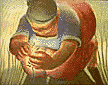 I've always liked nature. I feel it as a feminine force. This is what I
like to paint. The women I paint are part of nature, life-giving and
healing. I notice that most of the women I paint have bare feet. They're
close to the earth, grounded, secure. Big women exude that. I feel women
are more in tune with their feelings, more sensitive and more expressive
than men. I don't, for the most part, see men as nurturing, healing
forces. My husband's an exception: he's sensitive. But, on the whole, I
think testosterone gets in the way! I admire women with substance. There
should be no shame about being big. I say, Flaunt every inch. It's you,
the one and only you. Having shame diminishes the power and the strength
and the charisma that one can have: the greatness. If I were big, I'd
dress to the hilt in big, flowing things with lots of color. I'd be a
big woman with a big self-presence.
I've always liked nature. I feel it as a feminine force. This is what I
like to paint. The women I paint are part of nature, life-giving and
healing. I notice that most of the women I paint have bare feet. They're
close to the earth, grounded, secure. Big women exude that. I feel women
are more in tune with their feelings, more sensitive and more expressive
than men. I don't, for the most part, see men as nurturing, healing
forces. My husband's an exception: he's sensitive. But, on the whole, I
think testosterone gets in the way! I admire women with substance. There
should be no shame about being big. I say, Flaunt every inch. It's you,
the one and only you. Having shame diminishes the power and the strength
and the charisma that one can have: the greatness. If I were big, I'd
dress to the hilt in big, flowing things with lots of color. I'd be a
big woman with a big self-presence.
If you can make peace with your inner self, then your life will reflect that. Doing my art is my healing process. When I paint, I think about hugging that little girl inside of me. Sometimes the babies in my paintings are me, the child I'm putting my arms around, saying, It's going to be okay. So my work is really for me. My soul goes into my work. If I haven't painted for a while, I know I'm not very happy. Sometimes I get sort of burned out. When I'm painting, I'm very up and joyful to be around. My husband tells me sometimes that he thinks I need to get back to my work!
 Whatever I'm feeling goes into my work. The colors I use definitely
reflect my mood. Some of my work is more dark, and some is very light.
When I begin a painting, sometimes I take charcoal and just start making
circles. The canvas guides me. It's a spontaneous process. I never work
from a photograph or a model. Painting, for me, combines the conscious
and the unconscious. I work with the areas or shapes that are between
the lines: the arms, the figures, the flowingness, symmetry, all of
that. I paint intuitively. I don't struggle or plan. But when I'm almost
done with a painting, I'll turn it upside down and look at it to see if
it's balanced, if it's weighted at one end or the other. I want the
painting to be as balanced upside down as it is right side up. Or I look
at it through a reducing mirror and fine-tune it.
Whatever I'm feeling goes into my work. The colors I use definitely
reflect my mood. Some of my work is more dark, and some is very light.
When I begin a painting, sometimes I take charcoal and just start making
circles. The canvas guides me. It's a spontaneous process. I never work
from a photograph or a model. Painting, for me, combines the conscious
and the unconscious. I work with the areas or shapes that are between
the lines: the arms, the figures, the flowingness, symmetry, all of
that. I paint intuitively. I don't struggle or plan. But when I'm almost
done with a painting, I'll turn it upside down and look at it to see if
it's balanced, if it's weighted at one end or the other. I want the
painting to be as balanced upside down as it is right side up. Or I look
at it through a reducing mirror and fine-tune it.
 I love the freedom of making big, swooping curves on a canvas, of moving
my arms in a big way. It's kind of like dancing! Painting small is
tedious for me. My big paintings go up to six feet. Many of my
compositions have flowing, graceful lines, with arms encircling, in a
hug. The circular composition is gratifying, comforting. I guess I'm
still feeling the little girl inside me, because circles and hugs are a
focus of my work.
I love the freedom of making big, swooping curves on a canvas, of moving
my arms in a big way. It's kind of like dancing! Painting small is
tedious for me. My big paintings go up to six feet. Many of my
compositions have flowing, graceful lines, with arms encircling, in a
hug. The circular composition is gratifying, comforting. I guess I'm
still feeling the little girl inside me, because circles and hugs are a
focus of my work.
People feel the unconscious part of my work when they look at the paintings. They often say that they feel comforted; they feel a serenity in my work. People have told me that the more they look at my paintings, the more they get drawn into them.
SANDRA BIERMAN's original oils can be found in the following art galleries: Contemporary Southwest Galleries, Santa Fe, New Mexico; Suzanne Brown, Scottsdale, Arizona; Linton-Haslam Gallery, Boulder, Colorado; Jack Meier Gallery, Houston, Texas; and Gallery East, Loveland, Colorado. Custom orders are available by calling Sandra at 303-447-8871 at her studio in Boulder.
from Radiance, Winter 1998
Return to Reviews